On what happens to a population when there is nothing left that requires it
Listen to the audio version of this article.
There is a reliable way to destroy a population without taking a single thing away from it. You give it everything.
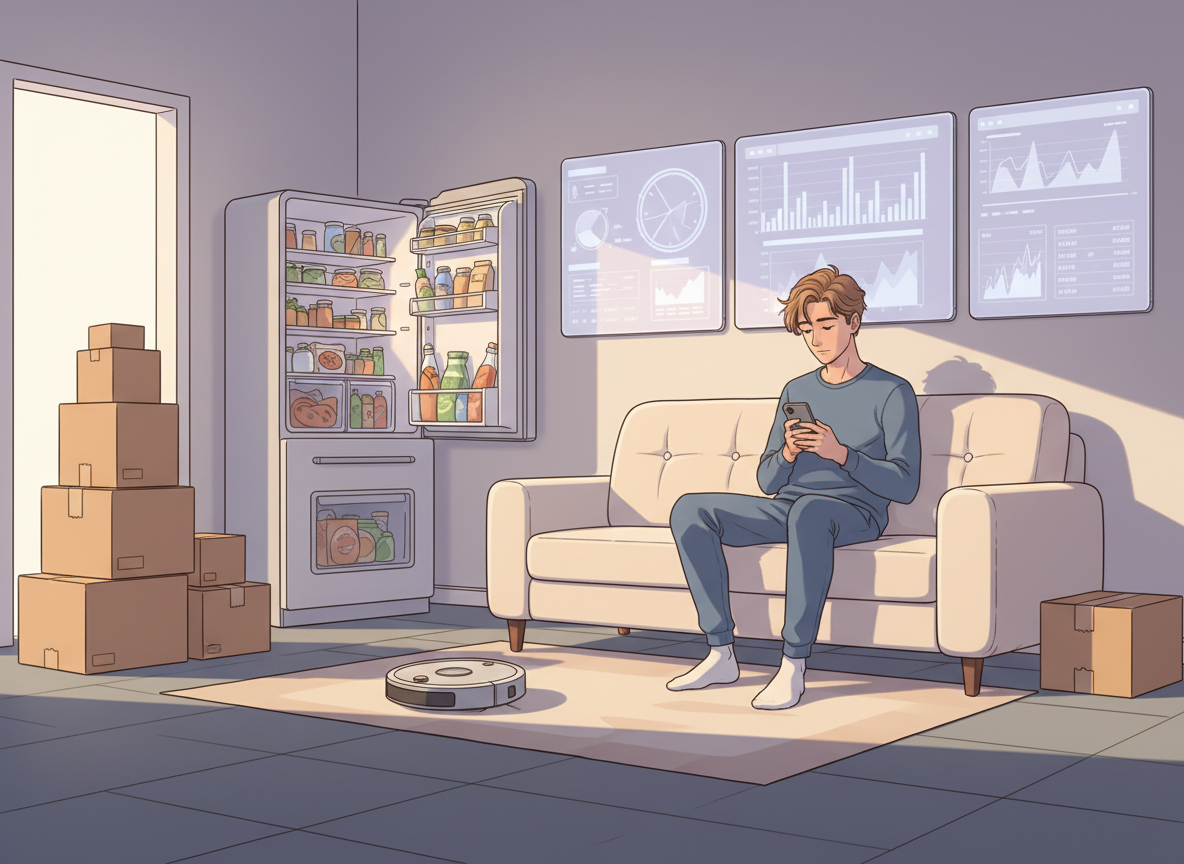
By the fourth year of the experiment, the most magnificent animals in the colony were also the most useless. Sleek, unscarred, in flawless physical condition, they spent their days eating, sleeping, and grooming themselves to a high gloss. They did not court. They did not fight. They did not defend territory or raise young. They maintained their own beauty until they died without issue, in a habitat that had never once run short of food.
TL;DR
- John Calhoun built a paradise for mice with unlimited food and no predators, and the colony went extinct anyway.
- It did not die of crowding. The enclosure was never full. It died of role saturation: every niche was permanently occupied, so each new generation grew up with nothing that required it.
- Organisms do not organize their lives around abundance. They organize around being needed.
- As AI absorbs more of what people are needed for, the niche that closes first is not the task. It is the responsibility attached to it.
- Ibn Khaldun described the same cycle in 1377. Hardship forges cohesion, cohesion builds abundance, abundance dissolves cohesion. It is a default, not a law.
- If the failure mode is role saturation rather than material scarcity, the answer is not nostalgia. It is the deliberate creation of genuine need. Some friction is load-bearing.
The man who built that habitat called them the beautiful ones, and their existence is the part of his work that should frighten us.
Because the colony did not fail from crowding. The enclosure was never full. It failed from the saturation of social roles. In an ordinary mouse population there is always a territory to claim, a rival to displace, young to protect, a job that must be done. In this one, every niche was permanently occupied by animals who would not vacate them and did not need to. Each new generation matured into a world with nothing left that required it.
That is the finding, and it is almost always left out of the retelling.
The scarcity that killed them was not a scarcity of resources. It was a scarcity of purpose.
Universe 25
In 1968, the ethologist John B. Calhoun built a utopia for mice at the National Institute of Mental Health: unlimited food and water, no predators, no disease, room for roughly 3,800 animals. He seeded it with four breeding pairs and watched.
The population peaked at about 2,200, well below capacity, and then collapsed to extinction over the following five years, in a paradise that had failed at nothing. Calhoun named the phenomenon the behavioral sink, and called the endpoint death squared: biological survival continuing after social death.
What this means for us
Organisms do not organize their lives around abundance. They organize around being needed. Remove the need, and abundance does not compensate. It accelerates the decline.
This reframes a question we are currently asking badly. Most anxiety about artificial intelligence is economic: which jobs go, what retraining looks like, how income gets redistributed. Those are serious questions, and they are also the easier ones, because money is a solvable problem. The harder question is Calhoun’s. If a system can write the brief, read the scan, draft the code, compose the music, and answer the customer, then the niches close. Not because anyone is cruel, but because they are already filled, competently, by something that does not tire and does not vacate.
And the niche that closes first is not the task. It is the responsibility attached to it. A role is not a list of things a person does; it is a set of outcomes a person is answerable for. When the model drafts the diagnosis and the clinician signs it, the task is still nominally hers, but the judgment has quietly migrated, and so has the weight. Do that across enough roles and you get a society of people who are formally accountable for work they no longer really perform. That is a stranger condition than unemployment, and harder to name. The mice at least knew they had nothing to do.
We know what happens to a species handed a fully provisioned world. We should be careful about assuming we differ in kind rather than only in degree.
The easy version of this argument, and why I distrust it
The familiar complaint writes itself. Each generation inherits more and is asked for less. Food arrives without cultivation, transport without navigation, answers without search. My grandparents grew what they ate in their own fields, and anything they could not grow meant a journey to the nearest large town, a full day gone to fetch what the village did not have. I push a cart down a lit and sorted aisle for twenty minutes, and the day is otherwise untouched. Responsibility, the argument goes, atrophies in proportion to the ease of the environment.
But ours is the first generation to be handed ease of a different kind. Every generation before us inherited better tools. We are inheriting conclusions. And responsibility, unlike comfort, cannot be handed to anyone. It exists only while it is being practiced.
The resemblance turns uncomfortably literal in places. There are young men now who have organized an entire life around the mirror: hours a day under the bar, the physique maintained as its own end, every set filmed and posted so the body can be sold back to an audience as a product. Flawless condition, no issue, endless grooming. Calhoun would have recognized the posture on sight.
But I am not sure he would have read it correctly. The beautiful ones withdrew. These people are competing, relentlessly, for status and income in a niche that did not exist twenty years ago. That is not a behavioral sink. That is a mouse who found an unclaimed corner of the enclosure and is defending it hard. When the old roles close, people invent strange new ones, and strangeness is not the same thing as decay.
I want to flag the rest of the weakness honestly too, because an essay that only flatters the reader’s instincts is not worth sharing. Every generation in recorded history has said this about the next one, which gives the claim a near-perfect record of being wrong. Calhoun’s work has drawn real methodological criticism, particularly for inviting the leap from rodent enclosures to human cities. And most of the young people I know are not doing any of this. They are carrying debt, climate dread, and a housing market that quietly deleted the entire life script their parents followed.
What survives the criticism is narrower and more useful. It is not that people become lazy when life is easy. It is that competence requires resistance, and when an environment stops resisting, competence has nothing to form against. That is a claim about environments, not about character.
The cycle, and the part we get wrong
Ibn Khaldun described this in the Muqaddimah in 1377, four centuries before anyone thought to build a mouse utopia. A group bound by hardship develops asabiyyah, a fierce solidarity, and uses it to build something. The generation raised inside that achievement inherits the comfort without the binding force that produced it. By the fourth generation the solidarity is gone, the structure is hollow, and it falls to some hungrier group at the margins. Hardship forges cohesion, cohesion builds abundance, abundance dissolves cohesion.
The usual reading is fatalistic and slightly self-satisfied: decline is inevitable, and conveniently, we are the last competent generation. I think that reading is lazy. The cycle is not a law of physics. It describes what happens by default when a society stops deliberately manufacturing the conditions that made it capable.
Which is the actionable part. If the collapse mechanism is role saturation rather than material scarcity, the response is not nostalgia and not austerity. It is the deliberate creation of genuine need: work that actually requires a person, responsibility that is really transferred rather than simulated, difficulty that is not optimized away because it was never inefficiency in the first place. Some friction is load-bearing.
We are, for the first time, in a position to design the enclosure rather than merely inhabit it. Calhoun’s mice had no say in theirs. That is the only meaningful difference between us and them, and it counts only if we use it.
What is one responsibility in your work that you would not hand over, even if something else could carry it faster?
References
Where a free copy exists it is listed first, followed by the publisher.
- Calhoun, J. B. (1973). Death Squared: The Explosive Growth and Demise of a Mouse Population. Proceedings of the Royal Society of Medicine, 66(1 Pt 2), 80–88. Free full text at PubMed Central
- Ramsden, E. & Adams, J. (2009). Escaping the Laboratory: The Rodent Experiments of John B. Calhoun and Their Cultural Influence. Journal of Social History, 42(3), 761–797. Open access at LSE Research Online. The best account of how the popular version of Calhoun’s work came to overshadow what he actually argued.
- The Calhoun Papers, a digitized archive of his writing across his working life. johnbcalhoun.com
- Universe 25 Experiment (2024). The Scientist. An accessible overview for anyone who wants the narrative rather than the paper.
- Ibn Khaldun (1377). The Muqaddimah: An Introduction to History, translated by Franz Rosenthal. Princeton Classics. No free edition of the Rosenthal translation is reliably hosted, so here is a background entry instead.


Leave a Reply